


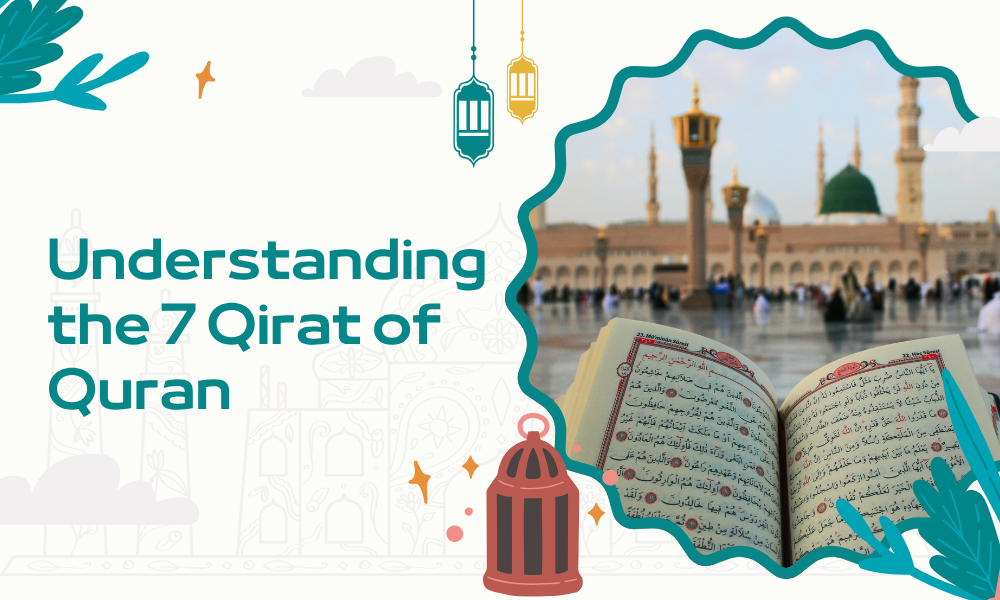
Understanding the 7 Qirat of Quran A Divine Diversity in Recitation
When we contemplate the beauty and the depth of the Quran, the 7 Qirat of Quran is one of the aspects that amazes scholars and students alike. This is not a variety of versions, but a variety of conflicting interpretations. It is an astonishing plurality of pronunciation and articulation, all revealed by Allah and fixed in the accuracy God himself secured. The knowledge of the Qirat of the Quran increases our awareness of the miraculous nature of the Quran and the adaptability it was able to provide to the early Muslim societies, who spoke various dialects.
What is a Qirat in Islam?
A Qirat is a particular style of reciting the Quran in Islamic tradition. The word comes from the Arabic “قراءة” (Qira’ah), meaning ‘reading’ or ‘recitation.’ These styles are founded on how the Prophet Muhammad (peace be upon him) instructed his companions to read the Quran by applying the different dialects of the Arab tribes, thus making the Quran easier to comprehend and memorize.
In a 7 Qirat of Quran hadith, narrated by Sahih Muslim, the Prophet himself stated:
“This Qur’an has been revealed to be recited in seven different ways, so recite it in whichever is easier for you.”
In this hadith, the importance is shown in the fact that the 7 Qirat of the Quran are sanctioned by God and are the miracle of revelation..
Join trusted online Quran classes and experience flexible, one-on-one learning with certified teachers from the comfort of home.
Meaning of Qirat
The term Qirat can be interpreted as the reciting process and also a reporting tradition pegged to a reciter. All the Qirats have their own style of saying specific words, elongation of words, and use of stops. There are no differences in meaning, but in phonetic expression, as it is the natural linguistic variety that existed at the moment of the revelation.
Each of the Qirats also has an authoritative chain of transmission to the Prophet (PBUH), a chain that lends it scholarly and spiritual authority.
Types of Qirat in the Quran
In total, 10 Qirat styles are identified; however, seven are the most well-known and most learned. When Muslims speak of the 7 Qirat of the Quran, they tend to refer to those that were most widely accepted over time by reciters and scholars alike.
Each type includes:
- A primary Qari (reciter)
- His two students, who preserved and transmitted the reading
- Specific linguistic and phonetic features unique to that style
Start your journey to learn Quran online with expert guidance, personalized classes, and a supportive Islamic learning environment.
The 7 Qirat of the Quran
Nafi‘ al-Madani
Nafi was a well-known reciter of Madinah. His Qirat has a softness and smooth flow that are melodic as described by many. His recitation was preserved and disseminated by two of his most well-known pupils, Qalun and Warsh. The Warsh narration is equally very common in North and West Africa. The grace of the pronunciation of the city of the Prophet can be seen in this Qirat.
Ibn Kathir al-Makki
Ibn Kathir was a very knowledgeable and very much respected person of piety, and he was born in Makkah. His Qirat is known by clear and open articulation. His two important reporters include al-Bazzi and Qunbul. This form of style was evident throughout the early Islamic centuries, and its characteristic is the presence of pauses and a preference for clarity.
Master the art of recitation and learn the Quran with Tajweed through step-by-step guidance from experienced and certified teachers.
Abu ‘Amr al-Basri
Having a Basra background, Abu Amr had come up with a recitation that is smooth-flowing and does not mix letters harshly. His Qirat is easy to pronounce, yet he does not lose Tajweed. Al-Duri and Al-Susi passed it down. Lots of scholars respect this kind of style as it has good use of natural transitions and tone.
Ibn ‘Amir ad-Dimashqi
Ibn Amir was a Damascus reciter whose Qirat is characterised by a heavy focus on extending the notes and meter. His students, Hisham and Ibn Dhakwan, played a major role in morphing his style. This recital was quite popular in Syria and is also popular due to its melodic design. It adds an element of lyricalness in the verses.
‘Asim al-Kufi
The Qirat of Asim, the recitation of Hafs, is the most common in the world today. His two students at Kufa, Hafs and Shu’bah, passed on the style clearly and consistently. Most of the printed editions of the Quran today use the Hafs an Asim recitation. It is a mixture of clarity and memorization, which aided in its adoption worldwide.
Hamzah al-Kufi
Hamzah, another recitation which was also out of Kufa, has heavy pronunciation and distinctive phonetic characteristics. It is a bit more elaborated in its articulation, particularly in stops and elongations. His style has been able to survive via Khalaf and Khallad. It is not that widely used nowadays, but still, it is respected by highly trained scholars and reciters.
Al-Kisai al-Kufi
Al-Kisai was a reciter of the Quran and a grammarian of Kufa. His Qirat is rhythmical and fine, which is influenced by his background in the knowledge of Arabic linguistics. His main students were al-Layth and Ad-Duri. The style has been valued due to its intellectual richness and correct rules of pronunciation, so it has been a popular style among researchers.
Achieve your goal of Quran memorization online with flexible classes, personalized support, and structured revision sessions.
Difference Between Tajweed and Qirat
It is also necessary not to mix Qirat with Tajweed. Qirat can be understood as the manner or style of reading, whereas Tajweed is a set of guidelines that should be applied when pronouncing letters, lengthening, and articulation in any form of Qirat.
Consider Tajweed as the grammar of recitation and the Qirat as the tone/accent to be used. It is possible to use Tajweed rules with various styles of Qirat. Which is to say, that Tajweed is universal, whereas Qirat is specific.
Learn Quranic Arabic online and unlock the meanings behind every verse with step-by-step, grammar-focused instruction.
Learn Qirat Online
With the rise of digital learning, it’s now easier than ever to study the 7 Qirat of the Quran from the comfort of your home. Online Quran academies offer structured courses, where certified scholars teach each Qirat with proper Tajweed.
Most courses begin with the Hafs and ‘Asim Qirat, then gradually introduce the remaining styles. Interactive sessions, audio recordings, and one-on-one guidance help learners internalize and master the differences among the 7 Qirats of the Quran. Many platforms even allow you to earn an ijazah (certification) in a specific recitation style (Qirat).
Whether you’re a beginner or a seasoned student, learning the 7 Qirat of the Quran online offers a rewarding spiritual experience.
Improve your Quran recitation with expert tutors who guide you on pronunciation, rhythm, and Tajweed rules.
Conclusion
The 7 Qirat of the Quran indicates the wisdom God used to teach with the Quran, in which it refers to the varieties of Arabic dialects and facilitates the ease of Quranic memory and recitation. Since the 7 Qirat of Quran hadith to the knowledge undertaken by the scholars that conserved every Quranic recital, the legacy of these styles is something that lives to date, affecting the Muslims at large.
Therefore, what are the 7 Qirat of the Quran? They are not some way of reading but rather they are the witnesses to the richness, the precision, and the universality of the Quran. When reading about the 7 Qirat of the Quran and learning the differences between them, each student of the Quran will connect more with the holy book. Be it learning offline or by opting to acquire Qirat on the internet, this experience introduces new aspects of faith and knowledge.